 English
 中文简体
中文简体



Call us
+86-15105800222
+86-15105800333


A technician checks the dial on a pump discharge line to confirm the reading is within the safe range. That quick visual check, repeated thousands of times daily, relies on one of the oldest instruments in industry: the pressure gauge.
A pressure gauge is an instrument that measures the pressure of a gas or liquid in a closed system and shows the value on a dial or digital screen. Most mechanical gauges need no external power: the pressure itself moves the pointer across a calibrated scale, making them the most economical way to monitor pressure across industrial, commercial, and household equipment.
A pressure gauge is not a transmitter. A gauge provides a local reading; a transmitter converts pressure into an electrical signal, such as 4-20 mA or Modbus, for a PLC or remote display. Many systems use both: a gauge for on-site verification and a transmitter for automatic control.
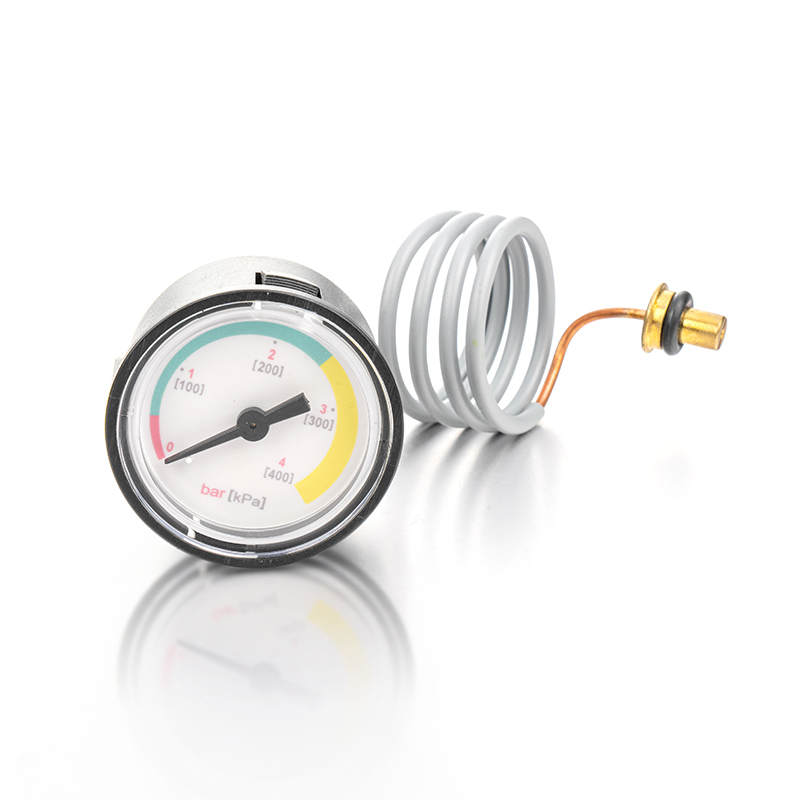
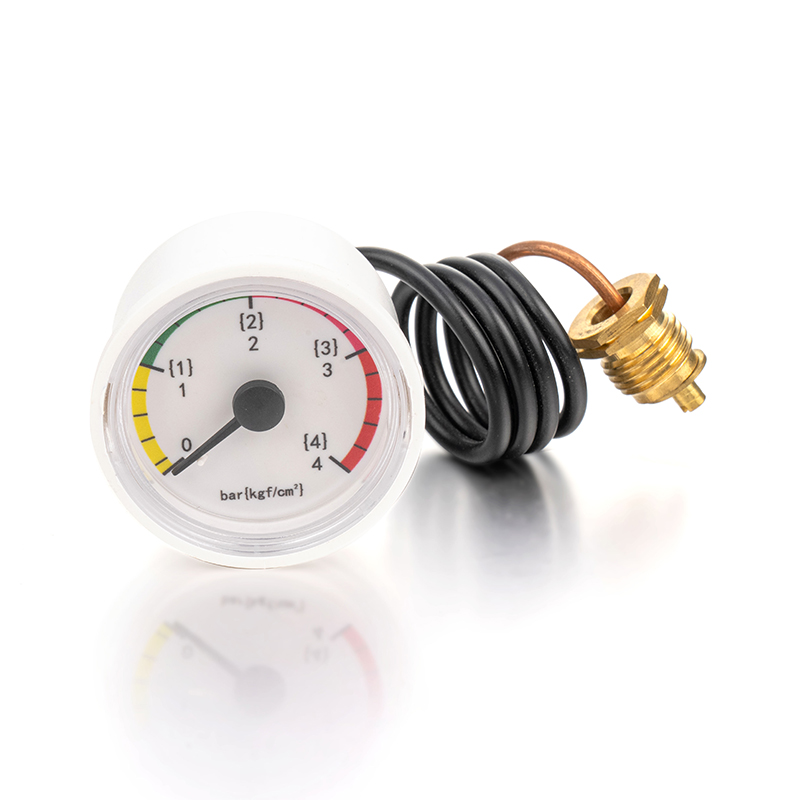
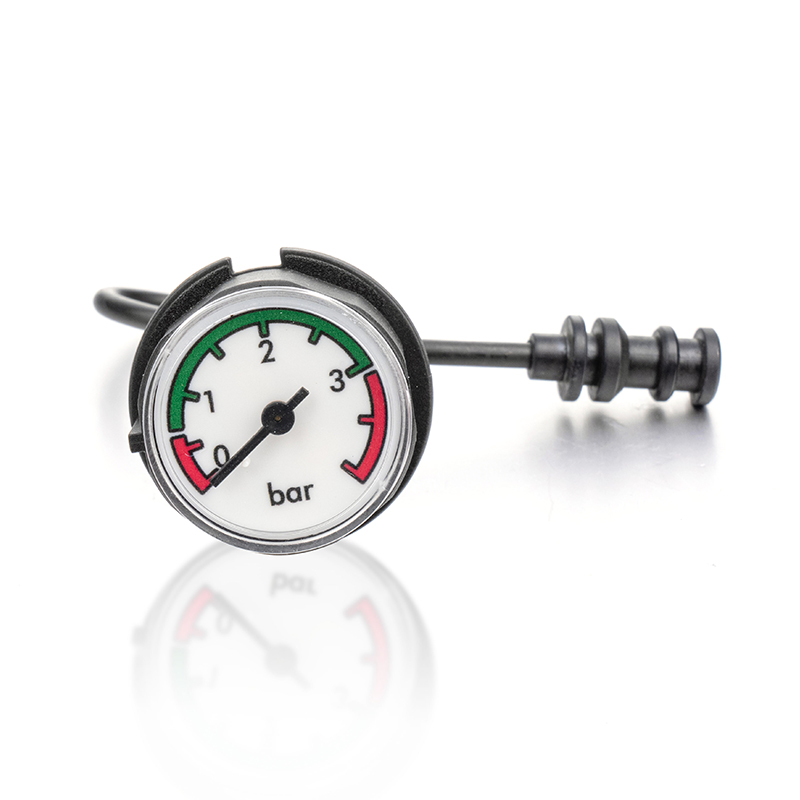
The most common configuration is the analog, direct-mounted gauge with a Bourdon tube and brass or stainless steel wetted parts. For a concrete example, common general-purpose pressure gauges like the Y60 series are a typical starting point for OEM equipment.
Inside a pressure gauge, the process pressure pushes against a flexible sensing element, and a gear train turns that motion into pointer rotation.
The Bourdon tube is the most widely used sensing element. It is a curved or helical metal tube with an oval cross-section. When pressure enters, the cross-section tries to become round, causing the tube to straighten slightly. That small displacement, often less than a millimeter, drives a linkage attached to the movement. Bourdon tubes are accurate, robust, and inexpensive, and they cover the widest range, from 60 mbar to several thousand bar.
Not every medium suits a Bourdon tube. A diaphragm element is a thin metal disc that deflects under pressure; diaphragm gauges measure lower pressures and, with a diaphragm seal, can handle viscous, contaminated, or corrosive media. A capsule element is made of two corrugated diaphragms welded together and is sensitive enough for very low pressures such as furnace draft. The choice of sensing element sets the usable pressure range and the media the gauge can safely contact.
The movement, a precision gear set, amplifies the deflection into pointer rotation. The case protects the mechanism; continuous vibration or pulsation calls for an oil-filled case, whose damping fluid steadies the pointer and lubricates the gears. The process connection, usually 1/4 in. NPT or 1/2 in. BSP, threads into the pipe, tank, or machine.
A pressure reading always refers to a reference point, and the reference determines what the gauge shows.
Absolute pressure is referenced to a perfect vacuum. It is the true pressure of the fluid, related to atmospheric pressure by Pabs = Pgauge + Patm. Absolute gauges contain an internal vacuum reference chamber, so readings do not shift with weather or altitude. Typical uses: barometric monitoring and vacuum coating.
Gauge pressure is referenced to atmospheric pressure. A standard gauge reads zero when open to atmosphere; the dial shows the pressure above ambient. Most industrial gauges, from air receivers to hydraulic presses and water pumps, display gauge pressure.
Differential pressure is the difference between two points. A differential gauge has two process connections and shows the difference directly; common uses include monitoring filter clogging, liquid level in sealed tanks, and flow across an orifice plate.
A compound gauge reads both vacuum and positive pressure on one scale, crossing zero in the middle. A tire-pressure gauge shows gauge pressure; a gauge monitoring vacuum in a packaging chamber needs an absolute or compound design.
Pressure gauges are built with different unit scales depending on regional standards. The table below lists the units you will meet most often.
| Unit | Definition | Typical Use |
|---|---|---|
| psi | pounds per square inch; 1 psi ≈ 6.895 kPa | North America; tire pressure, hydraulics, pneumatics |
| bar | 1 bar ≈ 100 kPa ≈ 14.5 psi | Europe; process piping, compressors, industrial gases |
| kPa / Pa | kilopascal or pascal; SI pressure units | HVAC, scientific and engineering applications |
| MPa | 1 MPa = 1,000 kPa = 10 bar | High-pressure hydraulics, water jet cutting |
| kgf/cm² | kilogram-force per square centimeter; ≈ 0.981 bar | Legacy equipment in Asia and parts of Europe |
For quick conversion, 1 bar is approximately 14.5 psi or 100 kPa, and 1 MPa equals 10 bar. Export equipment often uses dual-scale dials, such as psi and bar, to avoid errors.
Pressure gauges can be classified by reference, sensing element, and construction. These three viewpoints match a gauge to its working conditions.
This classification follows the reference explained above. A standard gauge measures relative to atmosphere; an absolute gauge contains a vacuum chamber; a differential gauge has two ports and shows the difference.
Bourdon tube gauges cover the widest range, from about 60 mbar to thousands of bar, and suit most general duties. Diaphragm gauges handle lower pressures and tolerate dirty or aggressive media. Capsule gauges are reserved for very low pressures, typically below 600 mbar, such as furnace draft.
When the process medium is viscous, carries particles, or tends to clog the sensing element, a diaphragm seal isolates the gauge internals. In municipal and industrial water plants, diaphragm-sealed gauges used in water treatment lines keep sludge and suspended solids from blocking the element while delivering a stable reading.
When the environment is corrosive, such as chemical plants or offshore platforms, all-stainless steel construction protects the wetted parts and the case. Petrochemical facilities combine stainless steel with an oil-filled case; oil-filled shockproof pressure gauges for petrochemical use are a standard specification in refineries and transfer stations.
For flammable gases or combustible dust, explosion-proof gauges with heavy-duty cases and flameproof joints prevent internal sparks from igniting the atmosphere.
Shockproof, oil-filled gauges are also common on mobile equipment; hydraulic power units, compressors, and marine engines generate vibration that would quickly fatigue a dry-case gauge.
Analog mechanical gauges remain the default for local indication: they need no power and survive rough use. Digital gauges offer higher accuracy, often 0.1% to 0.5% of full scale, and provide outputs for data logging or remote monitoring. They tolerate vibration well but need a battery and dislike extreme temperatures. The two are complementary: analog for direct reading, digital for precision.
Different industries create different pressure conditions, which is why manufacturers build gauges differently.
The same physical principle, where pressure deflects a sensing element, is applied differently in every industry. A refinery-grade gauge is useless inside a coffee machine: the media, environment, space, and safety standards are simply different.
A systematic approach prevents most selection errors. Work through these five steps.
When these parameters are clear, the selection range narrows quickly. For standard air, water, oil, and hydraulic duties, browse the complete range of general pressure gauges on the manufacturer's product page, and confirm media compatibility with the supplier before ordering.
Pressure gauges are dependable, but they are precision instruments that deserve basic care. Four habits cover most situations:
An isolation valve allows gauge removal without shutting down the process, and a snubber or siphon loop protects against water hammer and steam. With this care, a quality gauge can run for years. Replace the instrument when the dial becomes illegible, the needle sticks, or the case is damaged; an unexpected failure costs more than a new gauge.
A pressure gauge answers a question that appears constantly in engineering: what is the pressure in this system right now? Mechanical gauges answer it without electricity, at low cost, and with enough accuracy for most industrial and commercial applications.
Understanding how the sensing element works, how gauge pressure differs from absolute and differential readings, and why industries demand different constructions will help you specify the right instrument. Start with the media, the pressure range, and the installation environment. If any detail is unclear, contact a manufacturer with concrete process information and let a specialist recommend a tested model for your application.

+86-15105800222
+86-15105800333


Shuangtang Industrial Zone,Liuheng Town , Putuo District, Zhoushan City,Zhejiang Province,China
We will reply to you within 12 hours after receiving the inquiry on working days. Or, give us a call.
The information provided on this website is intended for use only in countries and jurisdictions outside of the People's Republic of China.
Copyright © Zhoushan Jiaerling Meter Co., Ltd. All Rights Reserved.
 Wholesale Pressure Gauge Factory
