 English
 中文简体
中文简体

Call us
+86-15105800222
+86-15105800333


Almost every pressure gauge on the market belongs to one of two families, and knowing the difference saves time, money, and maintenance headaches. By measuring principle, the two types of pressure gauges are mechanical pressure gauges and hydrostatic (liquid-column) pressure gauges. Mechanical gauges detect pressure through the elastic deformation of a metal element, while hydrostatic gauges balance the measured pressure against the height of a liquid column. This guide explains how each family works, the main sub-types you will encounter in the field, and the selection factors that matter most before you place an order.
The fastest way to classify a pressure gauge is to ask how it senses pressure. A mechanical gauge uses a deformable elastic element - usually a Bourdon tube, diaphragm, or capsule - that moves under pressure and drives a pointer through a linkage and gear train. A hydrostatic gauge uses the weight of a liquid column: pressure pushes the liquid upward until the column height balances the applied pressure, and the liquid level becomes the readable signal.
Mechanical gauges dominate industrial installations because they are rugged, self-contained, and available from a few inches of water to thousands of bar. Hydrostatic gauges survive mainly in laboratories, calibration benches, and low-differential-pressure work, where simplicity and the absence of moving parts are genuine advantages.
It is worth noting that "two types" can also refer to pressure reference. By reference, instruments divide into gauge pressure types and absolute pressure types. Both systems are valid; this article uses measuring principle as the primary framework and returns to reference classes in a later section.
Mechanical gauges are the default choice for most process, hydraulic, pneumatic, and HVAC systems. The operating principle is consistent across sub-types: pressure acts on an elastic element, the element deforms proportionally, a linkage amplifies the motion, and a gear mechanism rotates a pointer across a calibrated dial. The specific element determines each gauge's strengths and limits.
The Bourdon tube is the most widely used sensing element in industrial pressure measurement. A C-shaped or spiral tube tends to straighten when internal pressure rises; this motion is transmitted through a link to a sector-and-pinion gear that rotates the pointer.
Bourdon tube gauges cover medium to high pressure ranges, from a few bar to several thousand bar, making them suitable for hydraulics, compressors, steam lines, and refinery processes. They handle most clean gases and liquids but should be avoided for highly viscous or crystallizing media that can clog the tube.
For general-purpose duties, a standard Bourdon tube instrument such as the Y60 pressure gauge provides reliable indication across most routine industrial environments. When the process fluid is corrosive or the environment demands stainless steel wetted parts, an all-stainless-steel petrochemical gauge is the usual upgrade.
In a diaphragm gauge, pressure acts on a flexible circular diaphragm - a thin metal or elastomer disc clamped between flanges. The diaphragm deflects under pressure, and the deflection is transferred to the pointer mechanism through a push rod or lever.
The diaphragm design offers two practical advantages. First, it measures low pressures with better sensitivity than a Bourdon tube. Second, the diaphragm can be manufactured from, or coated with, corrosion-resistant materials such as PTFE, and its wide surface area resists clogging in viscous or particle-laden fluids.
For these reasons, diaphragm gauges are common in chemical processing, pharmaceuticals, food production, and water treatment. When the medium is aggressive or the line pressure is low, a diaphragm pressure gauge is often the safest choice, with wetted parts specified to match the process.
 Wholesale Diaphragm Type Pressure Gauge Manufacturers, FactoryAs China Diaphragm Type Pressure Gauge Manufacturers and Diaphragm Type Pressure Gauge Factory, Zhoushan Jiaerling Meter Co., Ltd. supply...View Product →
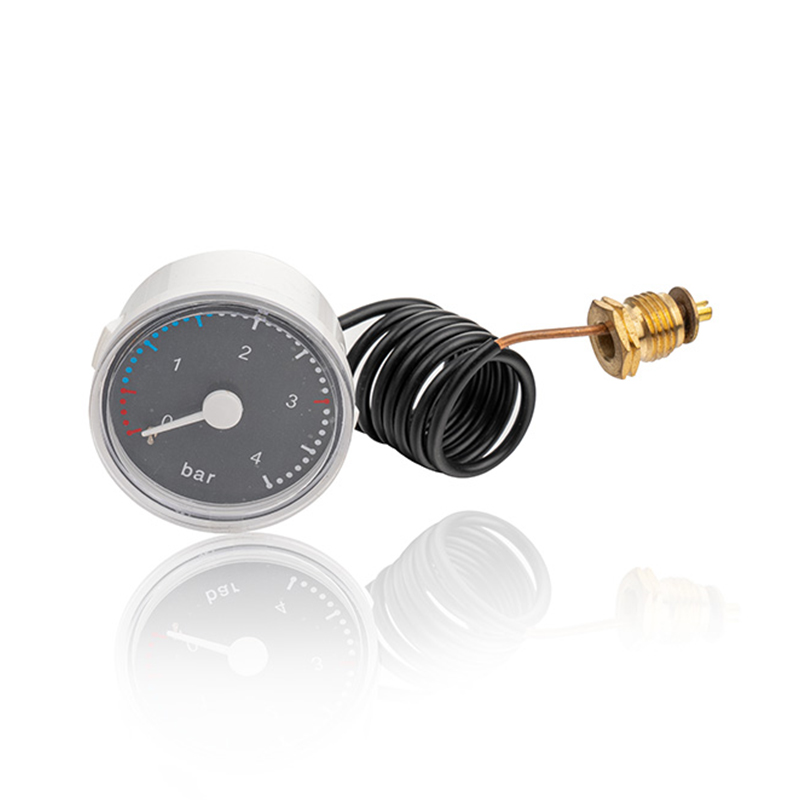
A capsule gauge consists of two circular diaphragms welded together at their edges to form a sealed capsule. When pressure enters the capsule, it expands or contracts slightly, and the resulting movement drives the pointer.
Because the effective area is large and the restoring force is small, capsule gauges excel at very low pressures and vacuum, typically from a few millibars to several hundred millibars. They are used for gas micro-pressure monitoring in ventilation ducts, burner combustion control, clean rooms, and laboratory air-pressure measurement.
For low-pressure gas service, a capsule pressure gauge provides the resolution that a Bourdon tube simply cannot achieve in this range.
Wholesale Capsule Pressure Gauge Manufacturers, FactoryAs China Capsule Pressure Gauge Manufacturers and Capsule Pressure Gauge Factory, Zhoushan Jiaerling Meter Co., Ltd. supply Wholesale Cap...View Product →Hydrostatic gauges - commonly called manometers - are the oldest pressure instruments still in use. They rely on the fact that a liquid column of known density exerts a pressure proportional to its height. The measured pressure is applied to one leg of the instrument; the liquid moves until the column height balances the applied pressure, and the difference in liquid levels is read against a scale.
Hydrostatic gauges remain valuable for laboratory calibration, low-differential-pressure measurement, and educational demonstrations because they need no power and have no moving parts. Their limitations are real: limited measurement range, a strict requirement for vertical mounting, and sensitivity to vibration and temperature. In modern industrial plants, hydrostatic gauges have been largely replaced by mechanical and electronic instruments, but no other technology matches their simplicity for precision low-pressure work.
Once you have settled on a measuring principle, you still need to choose the pressure reference - the second common meaning of "two types of pressure gauges." Gauge pressure is referenced to ambient atmospheric pressure: the gauge reads zero when open to the atmosphere, and the displayed value equals absolute pressure minus atmospheric pressure.
A tire pressure gauge is the everyday example. When it reads 0, the tire actually contains one atmosphere of pressure, so the instrument is displaying the pressure above atmospheric.
Absolute pressure is measured relative to a perfect vacuum and equals gauge pressure plus atmospheric pressure. Absolute pressure gauges are required when the process depends on true thermodynamic pressure, such as vacuum distillation, vapor pressure measurement, and altitude-sensitive applications.
A third reference, differential pressure, measures the difference between two process points rather than between the process and a fixed reference.
Selecting the wrong reference produces misleading readings and can create safety hazards. If a vessel is meant to operate at a specific absolute pressure, a gauge calibrated in gauge pressure can understate the true internal pressure by roughly one bar at sea level. When the signal must reach a controller, an HVAC pressure transducer converts the reading into a standard electrical output.
Choosing between mechanical and hydrostatic - and then between Bourdon, diaphragm, and capsule - becomes straightforward if you work through five decision steps.
The table below summarizes typical industry choices for each gauge family.
| Industry | Typical gauge type | Why it is selected |
|---|---|---|
| Petrochemical | All-stainless-steel, oil-filled, or diaphragm types | Corrosive media, high pressure, vibration |
| HVAC | Capillary gauges or pressure transducers | Remote reading and control-system integration |
| Water treatment | Diaphragm-seal pressure gauges | Clog resistance and corrosion-resistant wetted parts |
| Medical | Medical equipment pressure gauges | Clean, low-pressure air, oxygen, and vacuum service |
| Marine and automotive | Seismic, anti-fatigue, and oil pressure gauges | Vibration, shock, and mechanical fatigue resistance |
For water treatment duty specifically, a water treatment pressure gauge with diaphragm seal combines the low-pressure sensitivity of the diaphragm principle with the sealing protection needed for filtered water, chemical dosing, and sludge lines.
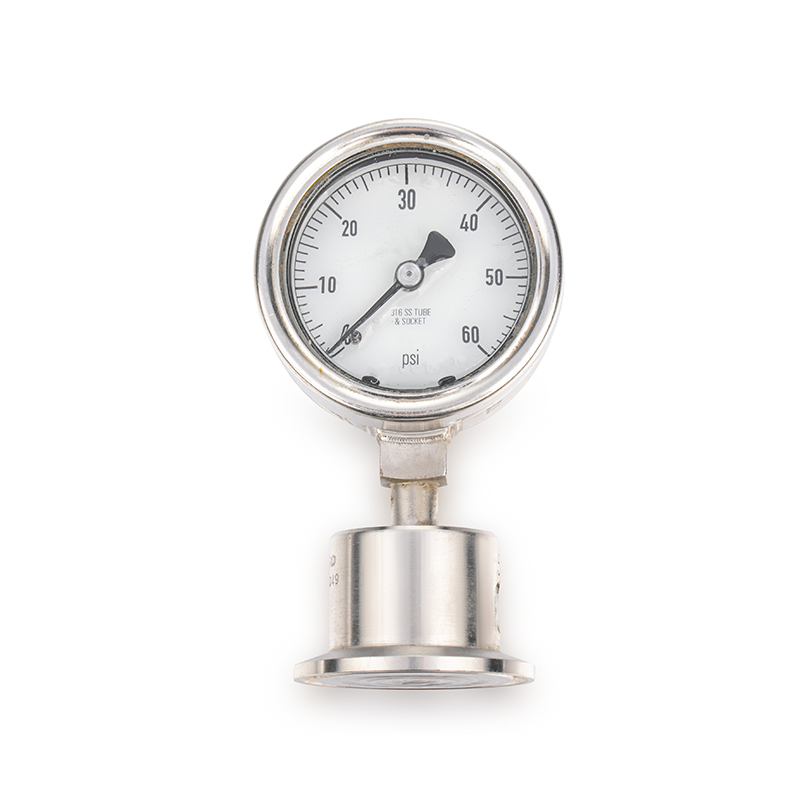 Wholesale Water Treatment Pressure Gauge with Diaphragm Seal Manufacturers, FactAs China Water Treatment Pressure Gauge with Diaphragm Seal Manufacturers and Water Treatment Pressure Gauge with Diaphragm Seal Factory,...View Product →
Is this classification purely academic? No. It has direct consequences for uptime, safety, and total cost of ownership.
A gauge that matches its duty is predictable: the pointer stays stable, the readings remain repeatable, and the instrument survives its planned service life. A mismatch produces recognizable failure modes. Installing an unfilled Bourdon tube gauge on a reciprocating pump delivers a bouncing pointer and accelerated gear wear. Placing a standard copper-alloy gauge on a corrosive chemical line leads to rapid corrosion and, in the worst case, a sudden loss of containment.
The practical takeaway is to define the process - pressure range, media, vibration, reference - before looking at price or delivery. When in doubt, discuss the application with the manufacturer; a specialist gauge maker can map your process conditions to a specific product family. You can review our pressure gauge product range by industry to see how each type is applied in practice.
Two organizing ideas will stay with you. By measuring principle, the two types of pressure gauges are mechanical (Bourdon tube, diaphragm, and capsule) and hydrostatic (liquid-column manometers). Mechanical gauges carry the overwhelming majority of industrial duties; hydrostatic gauges remain essential in calibration and low-pressure precision work. By pressure reference, instruments are classified as gauge, absolute, or differential pressure types, and the reference must match the process requirement.
When you specify your next gauge, start with the measuring principle, then confirm the reference, the wetted materials, and the environmental conditions. That sequence leads to a technically sound and cost-effective choice. For industry-specific solutions, browse our product categories and match the gauge family to your process.

+86-15105800222
+86-15105800333


Shuangtang Industrial Zone,Liuheng Town , Putuo District, Zhoushan City,Zhejiang Province,China
We will reply to you within 12 hours after receiving the inquiry on working days. Or, give us a call.
The information provided on this website is intended for use only in countries and jurisdictions outside of the People's Republic of China.
Copyright © Zhoushan Jiaerling Meter Co., Ltd. All Rights Reserved.
 Wholesale Pressure Gauge Factory
