 English
 中文简体


Call us
+86-15105800222
+86-15105800333


A service technician on a supermarket refrigeration rack reads 58 psig on the low side, 42 F at the suction line, and a 9 F evaporator split. The gauge is not the only instrument in that decision, but an HVAC pressure thermometer that shows pressure and temperature at the same tap removes one walk back to the van and one source of confusion. That is the practical value of this instrument: it shortens the distance between a raw pressure reading and a useful system diagnosis.
The conclusion first: select an HVAC pressure thermometer by the circuit it will serve, the temperature span it must show, the capillary and case arrangement that fits the panel, and the accuracy class the service team can actually verify. A beautiful dial with the wrong span is a decoration. A low-cost gauge with a capillary that kinks at the first door swing is an expensive return. The useful product is the one that repeats its reading after a hot summer, a cold winter, and a hundred service calls.
Reads gauge pressure at the suction, discharge, or liquid line. The scale must match the refrigerant and the normal operating band, not the highest pressure the system could ever see.
Shows a local temperature through a bimetallic element or a capillary-connected bulb. It is a separate measurement, not an automatic conversion of pressure.
Pressure plus temperature becomes superheat, subcooling, or a saturated-condition check. The gauge is useful only when both readings are readable at the same moment.
An HVAC pressure thermometer combines two mechanical movements in one case. The pressure side uses a Bourdon tube, capsule, or diaphragm element to move a pointer across a pressure scale. The temperature side uses a bimetallic coil or a liquid-filled bulb and capillary to move a second pointer across a temperature scale. The two scales sit on the same dial, but they do not calculate. The technician still has to compare the pressure reading with the refrigerant's saturation table and the temperature reading with the line temperature.
That distinction matters in selection. If the gauge is sold as a pressure thermometer, the buyer should confirm whether the temperature element is direct-mounted in the case or remote through a capillary. A direct-mounted element reads the air around the gauge, which is useful for ambient checks but not for a suction line fifty centimeters away. A capillary-connected bulb can be strapped to the line or inserted into a well, so it reads the surface or fluid the technician actually cares about.
The chart above is not a refrigerant table. It is a reminder that three numbers usually enter the conversation: pressure, temperature, and a calculated difference. The gauge should make those numbers easy to read at arm's length, in a dim mechanical room, with a flashlight in one hand. A 2.5-inch dial can be adequate for a packaged unit, but a 4-inch dial with bold scale divisions is easier to read on a rack or a chiller. The scale arc should leave enough space between the normal operating band and the red zone so the pointer does not sit against a printed label.
For field work, the most useful dial is not the busiest one. It shows the pressure unit clearly, repeats the same unit on the temperature scale, and avoids three competing scales that turn a quick check into a squint. Dual-scale gauges are common, but the primary unit should match the service team's standard. If the team works in psig and F, a dial that leads with bar and C will slow every call. If the team works across both, the secondary scale should be printed in a lighter weight so the eye can choose.
HVAC work covers packaged rooftop units, split systems, chillers, boiler rooms, refrigeration racks, and ventilation panels. A single pressure thermometer cannot serve all of them well. The table below is a selection starting point, not a catalog limit. The pressure range, temperature span, connection size, and case material should be confirmed against the actual system and the service team's method.
| Circuit or panel | Pressure side | Temperature span | Mounting choice | Buyer watch-out |
|---|---|---|---|---|
| Split AC suction line | Low-side gauge, often -30 inHg to 150 psig | -20 F to 120 F | Direct or short capillary | Scale must cover vacuum and low-pressure charging |
| Refrigeration rack | Compound gauge with high-side range | -40 F to 80 F | Remote bulb with protected capillary | Oil and vibration can fog a cheap window |
| Chilled water panel | 0 to 100 psig or 0 to 150 psig | 20 F to 120 F | Panel mount, back connection | Panel cut-out and bezel clearance |
| Boiler or hot water loop | 0 to 100 psig or higher | 80 F to 250 F | Direct mount with siphon or protection | Steam and hot water need temperature protection |
| Ventilation duct | Low differential or line pressure | 20 F to 100 F | Remote or duct probe | Air velocity can cause a false temperature reading |
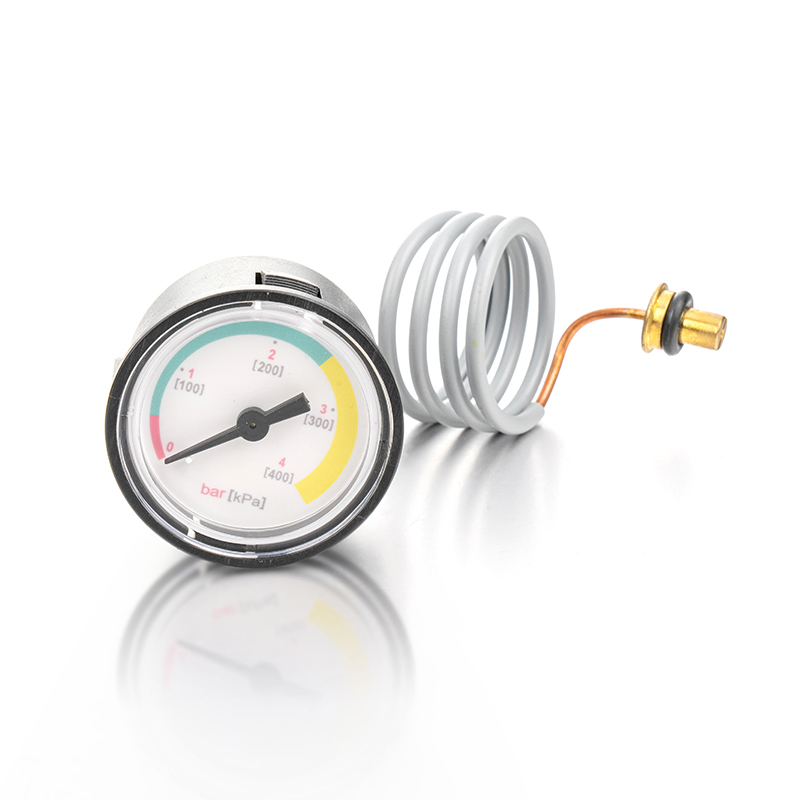
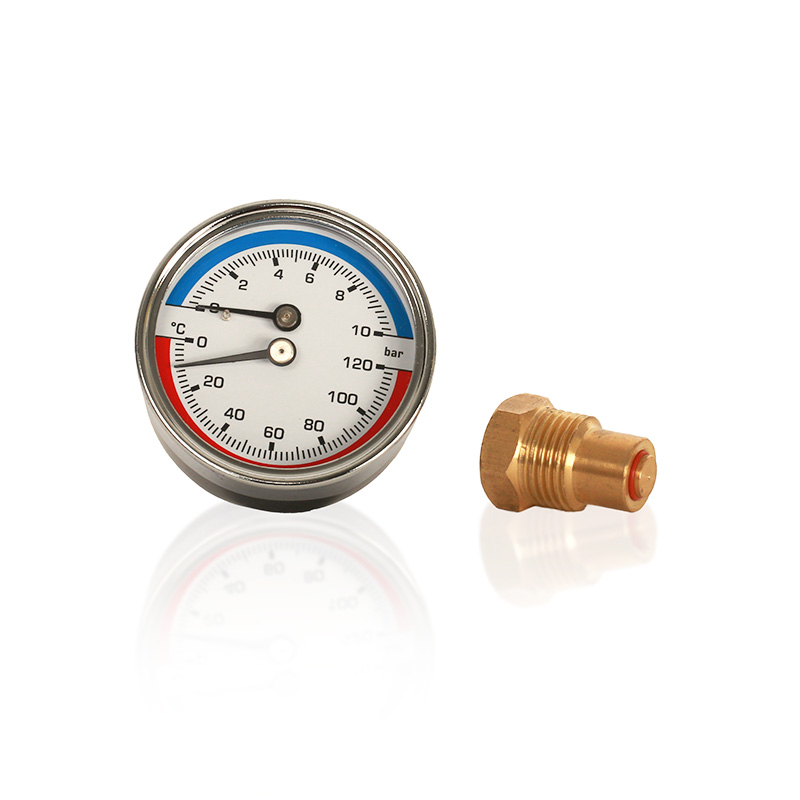 HVAC Pressure and Temperature ThermometerCombines pressure and temperature readings on one dial, helping HVAC teams select by circuit and confirm range, connection, and capillary needs.View Product →
Notice that the table begins with the circuit, not with the gauge body. A buyer who starts with a case diameter often ends up with a gauge that fits the panel but misses the operating band. A buyer who starts with the circuit can work backward to the dial size, connection, and capillary length. The order matters because a 2-inch gauge with a 0 to 500 psig range is not useful on a low-side charging port, even if the thread fits.
For mixed fleets, standardize the pressure unit and the temperature unit before standardizing the model number. A service company with three regions may prefer one dial layout, one connection size, and one capillary length for the most common calls, then keep a smaller set of specials for chillers and boilers. That approach reduces training time and spare-parts confusion. It also makes it easier to compare readings between technicians, because the scale divisions and the pointer interval are familiar.
Accuracy class is usually expressed as a percentage of the full scale span, not a percentage of the reading. A 2.5 percent gauge on a 0 to 300 psig scale can be off by about 7.5 psig at any point on the dial. That is not automatically a bad gauge. It becomes a problem when the technician uses a small pressure change to decide whether to add charge, replace a valve, or condemn a compressor. The accuracy budget has to fit the decision.
Common on better service gauges. On a 150 psig span, the window is about plus or minus 2.4 psig.
Common on general-purpose gauges. On a 300 psig span, the window is about plus or minus 7.5 psig.
Dial diameter is not accuracy, but a larger dial reduces reading error. A 4-inch dial is easier to interpolate than a 2-inch dial.
There is also a difference between accuracy at room temperature and accuracy after a case has been in a hot mechanical room for six hours. A glycerin-filled case dampens pointer flutter and protects the movement from vibration, but the fill does not correct a calibration shift. A liquid-filled gauge still needs a zero check and a known-pressure check. If the gauge has a fill plug, the installer should follow the manufacturer's instruction for venting or sealing the case; a plug left open can weep and a plug over-tightened can distort the window.
For procurement, ask for the accuracy class, the dial size, the scale span, and the temperature element tolerance as separate line items. Do not accept a single sentence such as "high accuracy" without a class. If the gauge is used for final charging or for a warranty decision, the accuracy class and the calibration method should be written into the purchase specification. If it is used for a quick visual check, a lower class may be acceptable, provided the scale divisions are coarse enough to show the normal band clearly.
A capillary is not a length of decorative tubing. It is part of the temperature measurement. The bulb, the capillary bore, and the case movement form a system. A long capillary with a small bore responds more slowly than a short capillary with a larger bore. A capillary routed around a sharp panel edge can kink, and a kinked capillary can trap the filled fluid or change the response. The installer should leave a service loop, avoid tight bends, and protect the run with a grommet or conduit where it passes through sheet metal.
Best for ambient or panel-air temperature. Keeps the installation compact. Not suitable when the sensing point is away from the gauge.
Useful for a nearby suction line or water pipe. Easier to route than a long run. Confirm the response time with the supplier.
Moves the reading to a convenient panel. Needs a protected route and a bulb pocket or strap that holds the bulb in contact.
Panel layout is where a good gauge can still fail. The operator needs to see the pressure scale and the temperature scale without opening a door or standing on a ladder. The case should clear the door swing, the connection should leave room for a wrench, and the capillary exit should not rub against the panel edge. If the gauge is mounted on a vibrating skid, a back-connection case with a panel clamp may be more stable than a bottom-connection case hanging on a pipe. The mounting style should be chosen with the service access in mind, not only with the drawing.
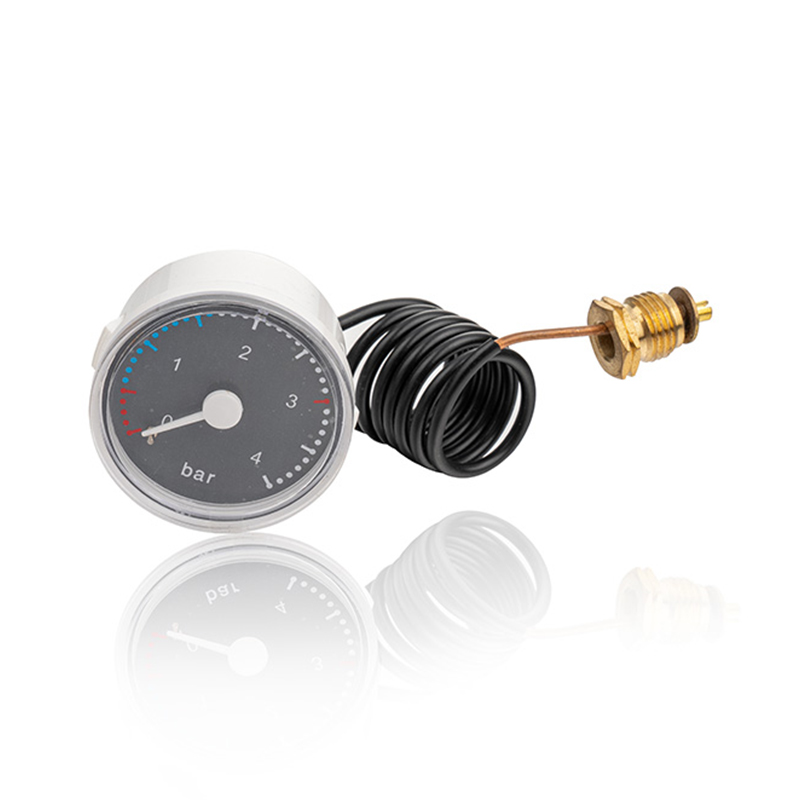
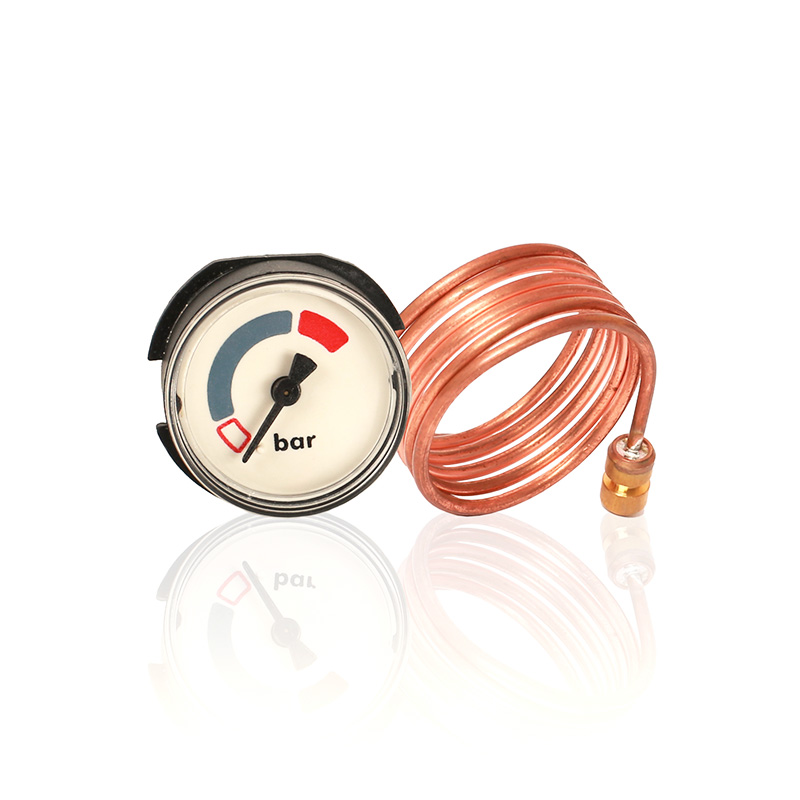 Y28 HVAC Pressure Gauge with Remote CapillaryRemote-reading gauge uses a capillary to reach line or duct sensing points, suiting wall-hung boilers, water heaters, and space-limited HVAC panels.View Product →
For a panel-based HVAC application, a panel-mount HVAC temperature gauge can simplify the cut-out and the bezel, while a pressure thermometer with a capillary handles the remote sensing point. The two choices are not interchangeable. The panel gauge fits the enclosure; the capillary gauge reaches the line. A good panel design often uses both: a direct pressure gauge at the service port and a remote temperature gauge at the line or duct.
One more detail: the capillary bulb should be in contact with the medium, not with the insulation or the pipe clamp. A bulb strapped to a bare pipe with a plastic tie will read the pipe surface, but a bulb pressed into a dry pocket will read the air in the pocket. The installation method changes the reading more than the catalog accuracy class. If the reading is used for a control decision, use a thermowell or a manufacturer-recommended bulb pocket and confirm the response time.
The wetted materials decide whether the gauge survives the medium. Brass is common in refrigeration and general HVAC service, but ammonia, some brines, and certain treated water loops require stainless steel or a diaphragm seal. A diaphragm seal isolates the Bourdon tube from a corrosive or dirty medium and transfers pressure through a fill fluid. That protection is useful, but it adds a temperature limit and a response time. The seal material, the fill fluid, and the connection size all need to match the application.
Check the refrigerant, oil, and charging practice. A gauge that is compatible with one refrigerant may not be the best choice for another.
Confirm the concentration and the expected temperature. A sealed gauge with a suitable wetted material reduces fogging and corrosion risk.
Use a siphon or a protection device. The gauge should not see live steam temperature at the Bourdon tube.
UV, rain, and freeze-thaw cycles age the case and window. A gasketed case and a stable mounting point matter.
An air-conditioning refrigerant pressure gauge is often selected with a compound scale for vacuum and low pressure, plus a high-side range for discharge checks. That dual role is convenient, but the scale must remain readable in the normal charging band. A gauge with a very wide high-side range can compress the low-side scale into a small arc, which makes fine charging difficult. If most calls are low-side checks, choose a gauge that gives the low side enough arc length rather than one that covers every possible system in one dial.
Case materials also affect service life. A painted steel case is fine in a dry mechanical room, but a stainless steel case is easier to clean and more resistant to a wet wash-down. The window material matters as well. Acrylic is common and clear, but it can craze with certain solvents. Polycarbonate is tougher but can yellow outdoors. The buyer should state the cleaning method and the ambient exposure, then let the supplier recommend the case and window. That conversation is more useful than a generic "outdoor" label.
A gauge that cannot be checked in the field will eventually be trusted for the wrong reason. The verification does not need a full laboratory procedure on every call, but it should be repeatable. Start with a zero check when the gauge is vented. Then compare it with a known pressure source or a reference gauge at two points: one near the normal operating band and one near the upper end of the scale. Record the reading, the reference, and the ambient temperature. If the error is outside the accuracy class, remove the gauge from service or mark it for adjustment.
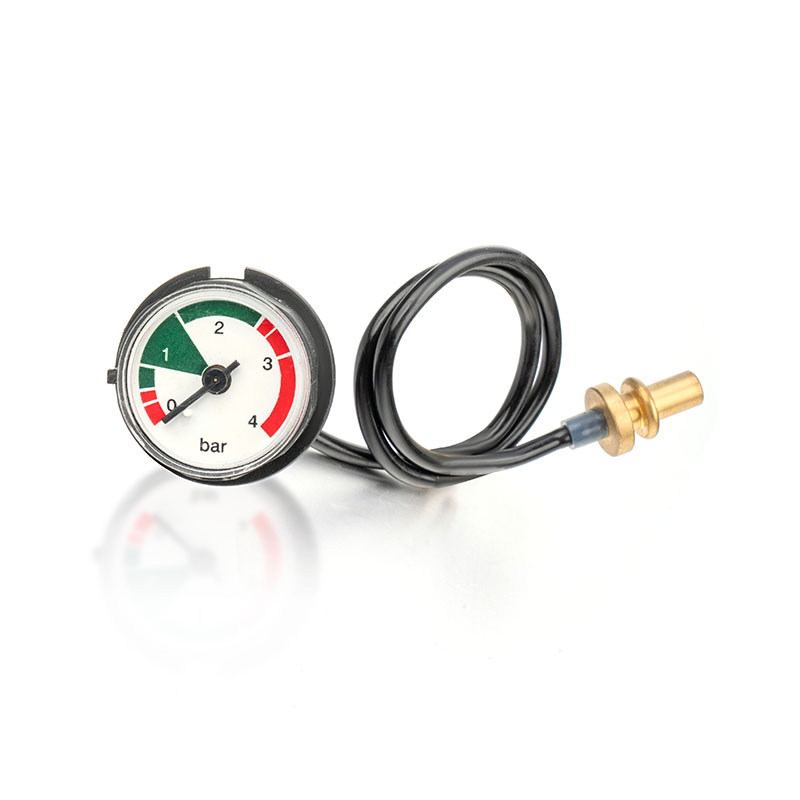
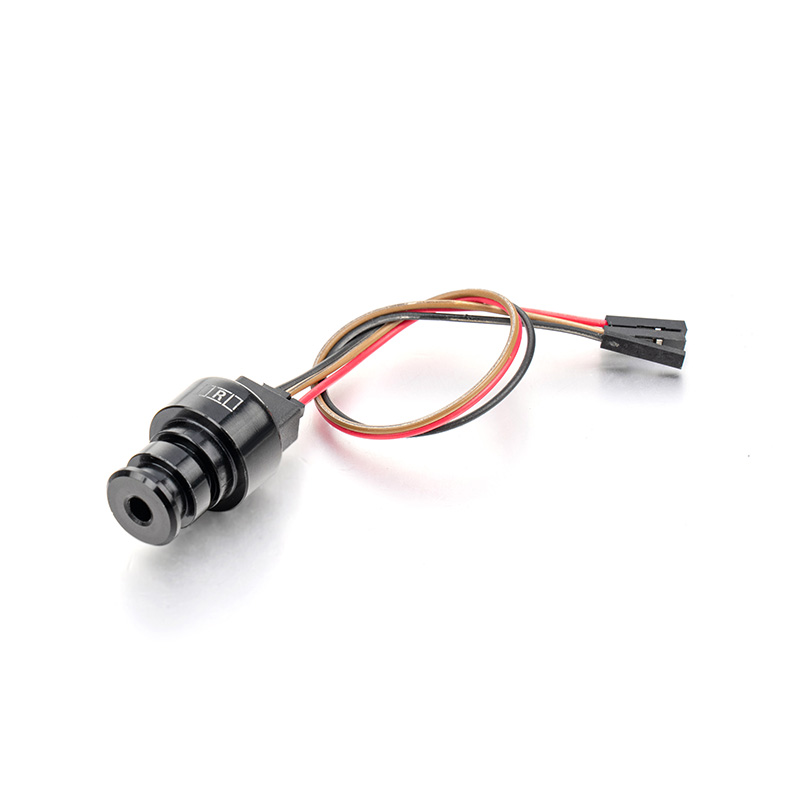 HVAC Pressure Transducer for Real-Time ControlConverts gas or liquid pressure into electrical output for HVAC control, with specified ranges, G1/4 connection, and IP65 protection.View Product →
When a panel needs a signal for a controller, a pressure transducer or sensor is often a better fit than a mechanical gauge. The transducer provides an electrical output, while the mechanical gauge provides a local visual check. Some panels use both: the transducer for control and the gauge for the technician. That arrangement is practical because the control signal and the local reading serve different purposes. The buyer should confirm the output range, the supply voltage, the pressure range, and the connection thread before mixing the two technologies on one panel.
Calibration frequency depends on the service environment. A clean laboratory panel may need an annual check. A vibrating rack with a glycerin-filled gauge may need a shorter interval, especially after a pointer flutter event. A gauge that has been exposed to a pressure spike should be checked before it is trusted again. The record should include the as-found error, the as-left error, and any adjustment. That record is more useful than a sticker with a date and no reading.
Most gauge failures tell a story before they become a return. A fogged window may mean a seal failure, but it can also mean the case was opened in a humid room and closed without a dry fill. A pointer that flutters may be a vibration problem, a worn movement, or a missing glycerin fill. A capillary that responds slowly may be kinked, trapped, or routed through a hot zone. The service technician should look at the installation before replacing the gauge.
Moisture inside the case. Check the window seal, the fill plug, and the assembly environment. A dry fill and a proper gasket reduce recurrence.
Vibration or pulsation. A liquid-filled case or a restrictor can dampen the movement. Check the mounting rigidity first.
Overpressure, a bent link, or a tired Bourdon tube. A zero check after venting is the first diagnostic step.
Bulb contact, capillary bore, or a pocket filled with air. The installation is often the cause, not the movement.
Thread mismatch, missing seal, over-torque, or a damaged seat. Confirm the thread standard and use the specified seal method.
Too many units or a crowded arc. A simpler dial with a clear normal band can reduce errors more than a higher accuracy class.
A gauge that fails in the same way across a fleet is a specification problem. If every outdoor unit shows a faded window after two summers, the window material is wrong for the exposure. If every rack gauge has a kinked capillary, the panel layout is wrong. If every technician misreads the low-side scale, the dial design is wrong. The corrective action should address the pattern, not only the individual unit. That is where a factory review of the failure sample, the installation photo, and the service record becomes useful.
A sample gauge can be perfect and a shipment can still disappoint. The gap is usually in the specification, not in the machining. Before a purchase order is released, confirm the pressure range, the temperature range, the connection thread, the mounting style, the capillary length, the case material, the window material, the fill fluid, the accuracy class, the scale artwork, and the packaging. Each item should have a written value, not a verbal "same as sample."
State the pressure span, the temperature span, the primary unit, the secondary unit, and the normal operating band. Approve the dial artwork before production.
Confirm thread standard, size, position, panel cut-out, bezel clearance, and wrench access. A drawing review prevents a costly first-article failure.
State the length, the bend radius, the bulb diameter, the bulb material, and the protection method. A service loop should be part of the installation instruction.
Identify the wetted parts, the case, the window, the gasket, and the fill fluid. Confirm the cleaning method and the ambient exposure.
Ask for the accuracy class, the test points, the calibration record, and the acceptance rule. A certificate without test points is hard to audit.
Confirm the label, the batch mark, the instruction sheet, the inner box, and the outer carton. Traceability helps when a field sample is returned.
On our HVAC production line, the most common custom request is not a new pressure range. It is a dial artwork change: a clearer normal band, a different unit order, or a larger temperature scale. That request is worth taking seriously because it affects every reading the technician makes. A gauge that is technically accurate but visually crowded will still produce errors. The buyer should ask for a printed proof at actual size and view it from the distance the operator will use, not only on a computer screen.
Another practical question is the first-article inspection. Ask for a sample from the production lot, not a hand-built showpiece. Check the pointer at zero, the scale alignment, the bezel fit, the capillary route, and the connection thread. Then compare it with the approved drawing. If the sample passes, keep the approved sample and the measurement record. A future shipment can be compared against that record instead of against memory. This is a simple control that prevents a slow drift in appearance and fit.
No. A mechanical pressure thermometer displays pressure and temperature. Superheat is a calculated value: the measured suction-line temperature minus the saturation temperature at the measured suction pressure. Some digital tools perform the calculation, but a mechanical gauge does not. The technician still needs a refrigerant table or a gauge with a saturation scale that matches the refrigerant.
Use direct mount when the temperature of the gauge location is the value you need, such as an ambient or panel-air check. Use a remote bulb and capillary when the sensing point is on a suction line, water pipe, duct, or vessel away from the gauge. The remote bulb must be in good contact with the medium and protected from a sharp bend or a hot surface.
It depends on the decision. A 2.5 percent gauge may be adequate for a visual check, but a 1.6 percent gauge is easier to defend when the reading is used for charging, warranty, or a control decision. Check the class against the full scale span, not the current reading. A small span with a lower class can have a smaller absolute error than a large span with a higher class.
Fogging usually means moisture entered the case or the case was closed in a humid environment. Check the window seal, the fill plug, and the gasket. A glycerin-filled case can still fog if the fill was contaminated or the plug was left loose. In a wet or outdoor location, specify a gasketed case and a window material that suits the cleaning method.
Yes, but the fill and the capillary should be specified together. The fill dampens pointer flutter and protects the movement; the capillary moves the temperature sensing point. The two features solve different problems. Confirm the fill fluid, the case seal, and the capillary route with the supplier, especially if the gauge will be mounted at an angle or exposed to freezing conditions.
Use a risk-based interval. A clean indoor panel may be checked annually. A vibrating rack, a steam loop, or an outdoor unit may need a shorter interval. Check after any pressure spike, a frozen line, a water hammer event, or a repair that disturbs the gauge. The record should include the as-found error, the as-left error, and the reference used.
The operating band and the scale layout. A gauge that covers the right pressure and temperature range but compresses the normal band into a small arc will be hard to use. Confirm the range, the normal band, the unit order, the dial size, and the viewing distance. Then confirm the connection, mounting, capillary, and materials. The visual specification is not cosmetic; it is part of the measurement.

+86-15105800222
+86-15105800333


Shuangtang Industrial Zone,Liuheng Town , Putuo District, Zhoushan City,Zhejiang Province,China
We will reply to you within 12 hours after receiving the inquiry on working days. Or, give us a call.
The information provided on this website is intended for use only in countries and jurisdictions outside of the People's Republic of China.
Copyright © Zhoushan Jiaerling Meter Co., Ltd. All Rights Reserved.
 Wholesale Pressure Gauge Factory
